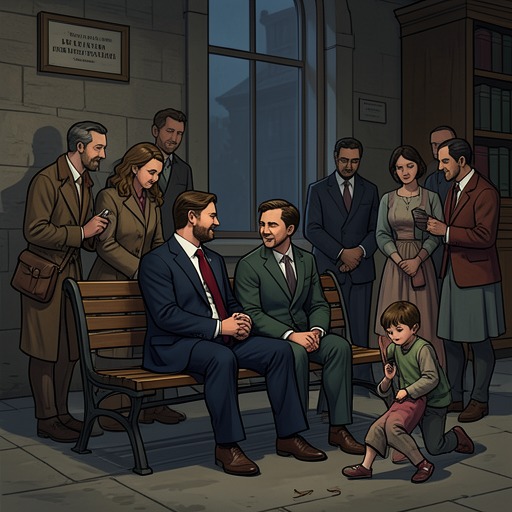
J.D. Vance’s marriage and adoption of the Vance surname
Hillbilly ElegyJ.D. Vance’s marriage to Usha, and their decision to adopt the Vance surname together, gave family belonging a public and personal form. Celebrated in Eastern Kentucky just two months before his mother’s relapse forced him to confront another family crisis, the wedding seemed to crown a life that had moved far from the instability of his childhood. In retrospect, its promise of arrival was real but incomplete: the life he had built did not sever his ties to the family he had come from.
The Wedding and Shared Name
J.D. Vance and Usha married on a beautiful day in Eastern Kentucky, with his entire family present. Both spouses changed their surname to Vance. For J.D. Vance, the choice meant finally sharing the name of the family to which he felt he belonged; it was not simply a marker of his marriage, but an explicit affirmation of family identity. The change was mutual, joining Usha to that identity as well.
A Household That Seemed Settled
At the time of the wedding, J.D. Vance had recently graduated from Yale Law School, served as an editor of the Yale Law Journal, and become a member of the bar in good standing. He and Usha had returned to Cincinnati for a year of clerkships after law school. They had bought a home there and built a life together with their two dogs. He described himself as upwardly mobile, with a good job, a loving relationship, and a happy life in a city he loved. From the outside, these circumstances made the marriage look like one part of a completed passage into security and achievement.
That apparent stability stood in sharp contrast to the repeated upheavals of his earlier life. During childhood, he moved from Middletown to Preble County, back to Middletown, and between homes shaped by changing partners in his mother’s life. After a brief stay with his father, he eventually moved in with Ken, a stranger to him. His later years in Mamaw’s home brought a different kind of continuity: through tenth, eleventh, and twelfth grade, he lived in the same house with the same person. Against that history, a shared surname and a home made with Usha carried particular weight as signs of chosen connection and permanence.
Achievement Meets Family Crisis
The memoir places the wedding close to a reversal. Two months later, J.D. Vance was arranging a hotel room for his homeless mother. Mom had begun using drugs again, had stolen family heirlooms from her fifth husband to buy drugs, and had been kicked out of the house as their marriage broke down. She had nowhere to go. The security suggested by the wedding and the household in Cincinnati did not keep the consequences of her addiction at a distance.
J.D. Vance had once vowed never to help Mom again, but by this point his understanding had changed. He was cautiously exploring the Christian faith he had left behind and had learned more about the emotional wounds of her childhood. He offered help rather than ending the call with anger. The wedding therefore sits beside, rather than in place of, the continuing demands of family: the shared name affirmed where he belonged, while the later crisis tested what that belonging required of him.
Significance
The marriage and surname change crystallize a tension in J.D. Vance’s account of upward mobility. He had achieved professional credentials, built a household with Usha, and found a life that had once seemed beyond reach. Yet success did not erase the family history that formed him or make his mother’s difficulties someone else’s concern. The Vance name expresses both a chosen future and an enduring connection to family; the events that follow show that belonging can be a source of stability without being a cure for inherited pain.